
The Myth of the Family Business

A number of well-known investors extoll the benefits of investing in family-run businesses. I used to be favorably inclined as well. The large ownership stakes, long time horizons and conservative financing of family businesses align with my own goals of steady compounding with minimal risk of a blow-up.
However, in reality, some of my worst returns have come from family-run companies. What gives?
Evidence in Favor of the Family-run Company
There is some evidence that family-run businesses outperform over time. Probably the most famous ongoing study of this phenomenon is from Credit Suisse (now UBS) and their Family 1000 index and annual report. CS finds that family-run companies generate ROIs 2% pts higher than peers, operate with less leverage, and their shares outperform by around 4%pt per year. CS also finds that while outperformance is strongest in the 1st and 2nd generation of leadership, it persists in the 3rd, 4th and 5th generation.
CS and others have posited that the long-term horizon and low leverage are key reasons behind this outperformance.
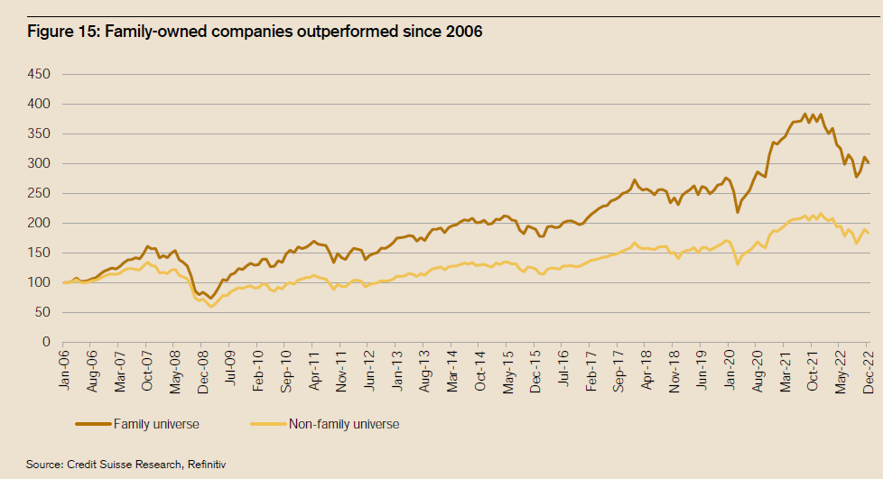
Source: Credit Suisse (UBS)
It certainly sounds plausible. Families with an inter-generational time horizon should be more prudent with the risks they take and ensure the survivorship of the company for their children and children's children.
I used to believe this story. Not anymore.
An Alternative Theory of Family-Run Business Outperformance: Cart Before the Horse
I have an alternative hypothesis as to why family-run companies outperform. What if performance attribution suffers from a wrong direction fallacy? What if the cause and effect have been reversed?
First, some baseline assumptions:
It should generally be hard for a family to maintain control over a company over multiple generations.
The need for capital can force dilutive equity financing, while fluctuations in the business cycle can lead to losses that also require equity financing or sales by owners.
Technological change may also favor startups over multi-generational firms.
Add in inheritance taxes and dilution caused by dividing ownership between multiple heirs, and it seems natural that families lose control over time.
Given these issues, what might a company that can reliably be passed down from generation to generation look like?
The business should be defensive relative to the overall economy, reducing the risk of losses and equity dilution. It should have limited technological risk. High margins would also help in giving owners enough wealth to withstand inheritance tax burdens. The ability to fund needed capital investments with debt, rather than equity, would also help owners maintain control, which relates back to defensiveness.
Some industries that satisfy most of these criteria include luxury goods, alcoholic beverages, and consumer staples. And what do you know, the CS 1000 list is peppered with companies including Hermes, Heineken and Hershey.
So instead of saying family-run companies generate superior long-term returns, perhaps we should say that businesses with superior economics lead to long-term family ownership. Alternatively, companies with bad economics will have limited family ownership as they are diluted over time.
Thus, my conclusion is that there is probably no secret sauce in families themselves. Rather, some families are beneficiaries of being associated with excellent business models.
My Own Experience with Family-run Businesses
I have been researching and investing in Japanese small caps for 13 years and have witnessed numerous transitions from founder to son (always the son, sadly). The results are often underwhelming.
The Extraordinary Founder vs. the Dilettante Son
Founding a company and growing it to $100mn in revenue and 500+ employees makes for a tiny listed company, but is nonetheless an extraordinary accomplishment.
Japan is a country of 120 million people, with about 1 million companies in total. How many people will be able to achieve this $100mn revenue feat in each generation? Maybe 500 – 1,000, or less than 0.001% of people, a 5 standard deviation outlier. Founders are, by definition, way out on the curve in terms of drive, intelligence, organizational skills and other factors that can all be lumped under "entrepreneurship."
Where is the founder's eldest son likely to fall on that same curve? Will lightning strike twice and he is also a 5-standard deviation personality? My experience has been that the son is quite often squarely average in terms of entrepreneurship and business acumen.

Source: TriVista, M. W. Toews https://commons.wikimedia.org/w/index.php?curid=1903871
Is it any wonder that mediocre results are produced after the baton is passed?
Below are some of the evidence of mediocrity I have observed when the son takes over:
Company 1: A son so introverted he is incapable of the top-level sales work needed to land large accounts
Company 2: A charity program sponsoring the son's favorite hobby being increasingly featured in company materials (and presumably using up a lot of CEO time)
Company 3: A mass-market TV advertising campaign starring the son
Company 4: A son who "diversified" the business away from their oligopolistic market to ramen shops
For obvious reasons, these companies will remain anonymous, but I present the Topix-relative share price performance of each over the first 60 months since the son assumed the CEO role.

Source: TriVista, Bloomberg
Evidence Against Family Successors
There is some interesting research from Francisco Perez-Gonzalez on this subject. He finds that in contrast to the popular narrative, when leadership passes to another family member, the ROA declines by 18% and the P/B ratio by 12% relative to leadership transitioning from the family to professional management. Furthermore, he finds that almost all of this decline is attributable to succession by family members who attended 2nd-tier or lower universities. If the scion attended a top-100 school, there was no deterioration in firm performance.
I think this supports my own theory that the son of the founder is most likely to be average in terms of business acumen, and thus a major step down from the founder.
A Bozo Explosion
Steve Jobs originated the Bozo Explosion theory. He posited that highly talented A players want to work with, and will hire, other A players. B players hire C players to protect their position, while C players also hire down. Meanwhile, A players quit when it fills up with less-talented people. So, once you start hiring B players, you're company is finished.
What type of people will the son surround himself with? In my experience, they form an executive team of B and C players, resulting in ceding position to competitors.
Conclusion
This turned into a very negative essay, but that was not really the point. My point is that we should avoid relying on heuristics such as "family businesses are better-run and outperform" and instead deeply reflect about the quality and drive of the specific person running the company, family member or not.
In small caps, I think over half of your return will be determined by the executive team and the culture they create. Less than half your return will come from industry or product dynamics. This is the largest different between investing in large companies vs. small companies, in my view.
There are exceptional sons of founders who I am more than happy to invest alongside. In my personal view, Mr. Iwamoto at I'LL (3854) or Mr. Fujisaki at Aucnet (3964) are examples of sons who have demonstrated themselves to be thoughtful and capable leaders and whose individual track records would qualify them to become CEO.
Likewise, I am more than happy to invest with a non-family "salaryman" CEO who has demonstrated a drive to succeed and independence of thought. The difference in results between investing alongside the highest quality people and everyone in the middle is large, in my view.
Ultimately, the Hosomichi strategy is about investing in people.
If you made it this far, thanks for reading!
Note: How do we square the Gonzalez research with Credit Suisse’s findings? It seems CS conflates founder-led companies with family-run companies. Founders are a totally different class from family-run businesses, in my view. The excess returns generated by founders is well-documented. I think if CS removed the founder-led companies from their study (Meta, Tesla, Alphabet, etc.) the results would be quite different.


Comments